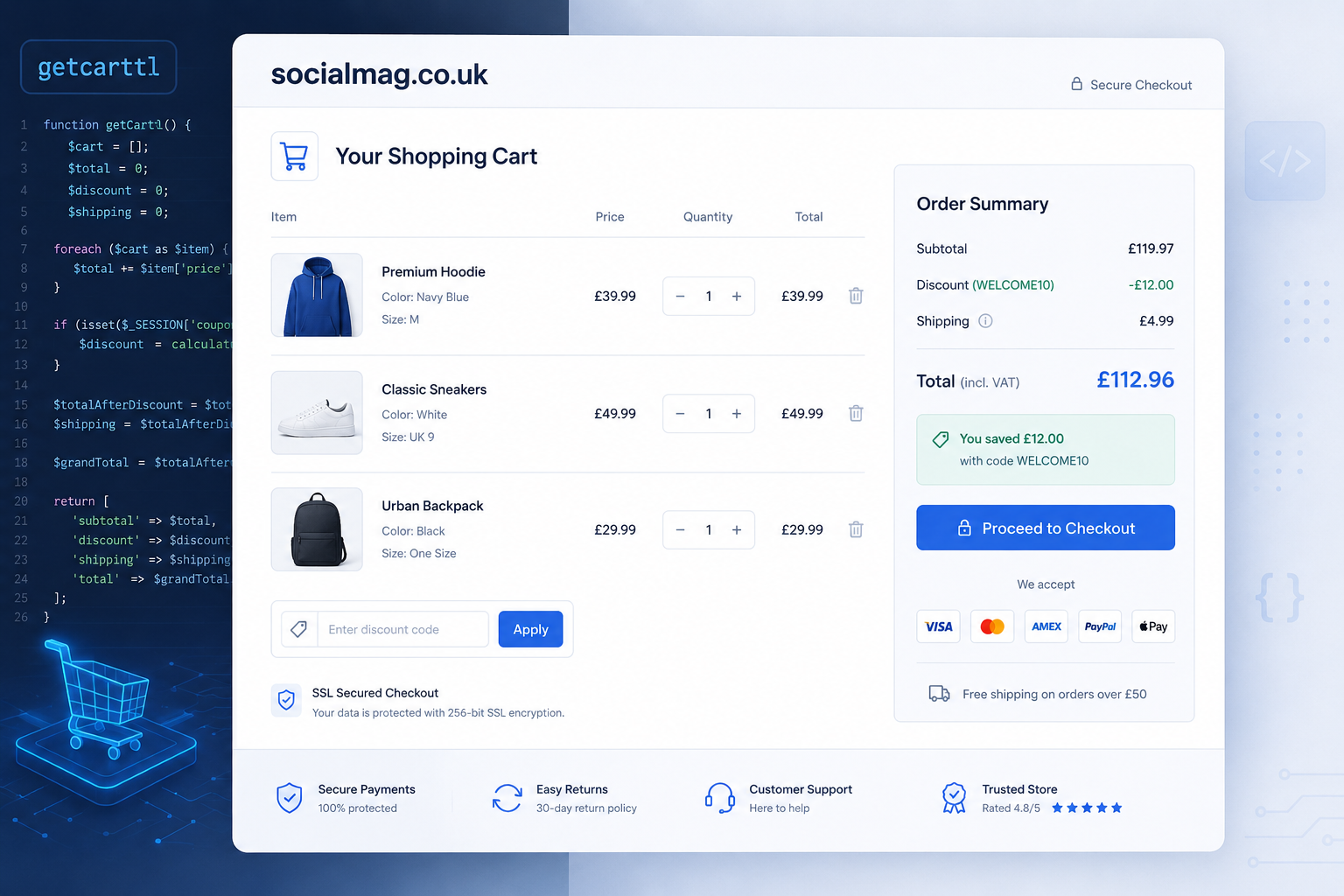
Getcarttl refers to a function or logic layer responsible for calculating the total value of items in a shopping cart.
Think of it like a digital cashier.
Instead of scanning physical products, it:
- Reads items in a cart
- Checks their price
- Multiplies by quantity
- Applies discounts or coupons
- Adds tax or shipping
- Returns the final payable amount
So, if we simplify it, getcarttl = cart total calculator logic.
In most real-world applications, this is not just one function. It’s a combination of rules, calculations, and validations working together to ensure the final price is correct.
And that correctness matters more than most people think.
A small mistake in cart total logic can lead to:
- Revenue loss
- Overcharging customers
- Broken checkout systems
- Trust issues with users
So yes, it’s a small name—but a big responsibility.
How GetCartTL Works (Overview)
Let’s walk through it like a real system would process it.
Imagine a cart like this:
- Product A → $20 × 2
- Product B → $50 × 1
- Discount → 10%
- Tax → 5%
A typical getcarttl flow works like this:
Step 1: Read Cart Items
The system fetches all items stored in the user’s cart session or database.
Step 2: Calculate Subtotal
Each item is multiplied by its quantity.
Subtotal formula:
Subtotal = (Price × Quantity) for all items
Step 3: Apply Discounts
Coupons, promotions, or seasonal discounts are applied here.
Step 4: Add Taxes
Depending on region or rules, tax is added on top of the discounted price.
Step 5: Final Calculation
Everything is summed into one final number.
That final number is what the user sees before checkout.
Simple on the surface. Carefully layered underneath.
Key Features or Main Benefits of GetCartTL Logic
Even though it sounds technical, the idea behind getcarttl brings some very practical advantages.
1. Accuracy in Pricing
No guesswork. Every cent is calculated based on rules.
2. Better User Experience
Customers see clear, transparent pricing without surprises.
3. Automation
No manual calculations needed—everything is handled by code.
4. Scalability
Whether a cart has 1 item or 100 items, the logic handles it smoothly.
5. Flexibility
You can plug in discounts, taxes, or shipping rules without rewriting everything.
What this really means is: a good cart system quietly reduces chaos behind the scenes.
Advantages and Disadvantages of GetCartTL Systems
Let’s keep it real. No system is perfect.
Advantages
- Fast real-time calculations
- Easy integration with eCommerce platforms
- Reduces human error
- Supports dynamic pricing models
- Works across devices and platforms
Disadvantages
- Can become complex in large systems
- Requires careful testing
- Edge cases (like stacked discounts) can break logic
- Poor implementation can lead to pricing bugs
The truth is, most problems don’t come from the idea itself—they come from how it’s implemented.
Practical Uses / Real-Life Applications
You might be surprised how often getcarttl-style logic is used.
1. Online Stores
Every eCommerce website depends on it—Amazon-style platforms, small Shopify stores, and everything in between.
2. Food Delivery Apps
Your meal total, delivery fee, and discounts are all calculated in real time.
3. Subscription Platforms
Monthly billing systems calculate totals based on plans, add-ons, and taxes.
4. Booking Systems
Hotels, flights, and travel apps all rely on cart-like total calculations.
5. Digital Marketplaces
From software licenses to online courses, everything goes through similar logic.
So even if you never see “getcarttl” written anywhere, you’re using it every day.
Important Insights About GetCartTL
Here are a few things developers and product teams learn over time:
Pricing Logic is Never Just Math
It’s business logic disguised as math.
Order of Operations Matters
Discount before tax vs tax before discount can completely change the result.
Edge Cases Are Everywhere
What happens if:
- A coupon expires mid-checkout?
- A product price changes in real time?
- A user adds an item from two tabs?
These are the details that break systems.
Transparency Builds Trust
Users don’t like hidden costs. Clear breakdowns improve conversion rates.
Comparison: Simple Cart Total vs Advanced GetCartTL Systems
| Feature | Basic Cart Total | Advanced GetCartTL |
|---|---|---|
| Calculation | Simple sum | Multi-layer rules |
| Discounts | Not supported | Fully dynamic |
| Taxes | Fixed | Location-based |
| Scalability | Low | High |
| Business logic | Minimal | Complex & customizable |
In short, simple systems work for small projects. But real-world platforms need structured logic like getcarttl.
Common Mistakes or Problems
Even experienced developers slip up here.
1. Ignoring Rounding Errors
Small decimal issues can snowball into big financial discrepancies.
2. Mixing Business Rules
Discount logic and tax logic should stay separate—but often don’t.
3. Not Handling Empty Carts
Sounds basic, but it still breaks apps.
4. Double Counting Items
A sync issue between UI and backend can duplicate charges.
5. Hardcoding Prices
This kills flexibility and leads to maintenance nightmares.
Expert Tips and Best Practices
If you’re building or optimizing a system like getcarttl, here’s what actually helps:
Keep Logic Modular
Separate discounts, taxes, and totals into different functions.
Always Validate Input
Never trust frontend data blindly.
Test Edge Cases Aggressively
Especially around discounts and price updates.
Log Everything
When something breaks, logs save time.
Keep Business Rules Configurable
Avoid rewriting code every time pricing changes.
This is where experience really shows its value.
Conclusion
At first glance, getcarttl sounds like just another technical term. But once you break it down, it’s actually one of the most important pieces in any digital commerce system.
It’s the point where business rules meet user experience. Where numbers become trust. Where a simple checkout button becomes a carefully calculated decision engine.
And the interesting part? Users never see it. But they feel it every time it works—or fails.
That’s why understanding this logic isn’t just useful for developers. It’s useful for anyone building or working with digital products that involve money.
FAQs About GetCartTL
1. What does getcarttl mean in simple terms?
It refers to the logic or function that calculates the total price of items in a shopping cart.
2. Is getcarttl a real programming function?
Not officially. It’s more of a conceptual or custom function name used in projects.
3. Why is cart total logic important?
Because it directly affects pricing accuracy, user trust, and revenue.
4. Can getcarttl handle discounts and taxes?
Yes, in most real systems it includes discounts, taxes, and shipping calculations.
5. What causes errors in cart total systems?
Common issues include rounding mistakes, incorrect discount stacking, and poor data syncing.
Read also: Who is debby clarke belichick? The Complete Guide